


Q&A session with Coach Jayaraj G Talawar

Updated: Mar 16, 2023
“In UK and US there is a sports culture. Here in India not many parents encourage their kids to play football.”
“As a coach, I would advice the girls to enjoy the game and practice as often as you can. Even if it’s with boys in the street, keep faith in your abilities, and work harder to improve every day.”
Interview by Anupama
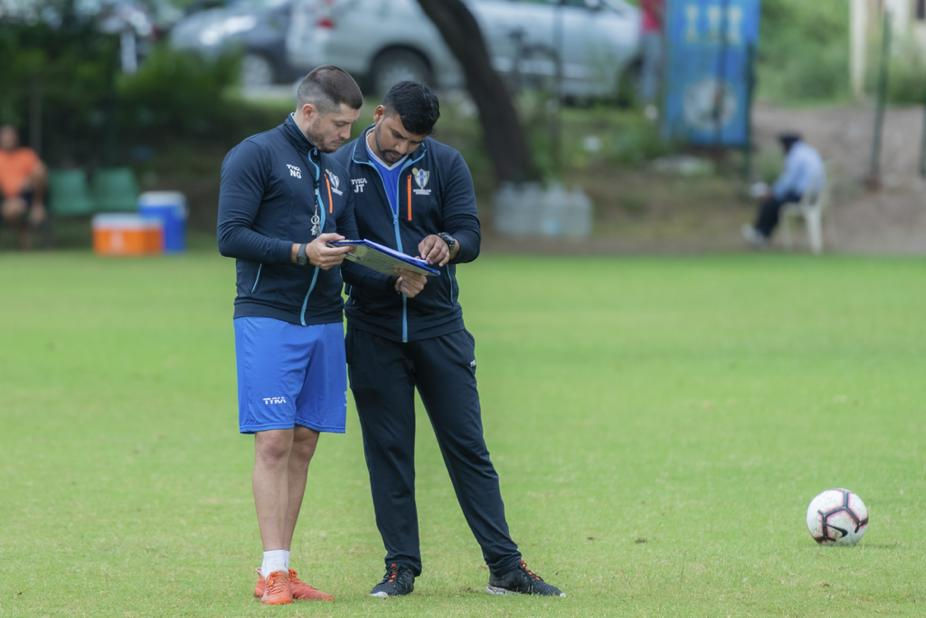
Jayaraj G Talawar with a colleague during trails in Punjab FC
Jayaraj G Talawar, a UEFA B licensed football coach with a football coaching degree from Uni of South Wales, UK and experience of coaching in the UK, US and India across all age groups from U-8 to U-19 is currently working with Round Glass Punjab FC and is trying to improve the quality and potential of young footballers.
Q. Having coached age groups from U-8 to U-19, what do you think of their potential and also the possibilities and opportunities prevailing in India for their career development?
First, U-8 to U-19 is a very broad age range. In Europe, the academy program is divided into 3 groups.
A) Foundation Phase (U-8 to U-12)
B) Development Phase (U-13 to U-16)
C) Performance phase (U-17 to U-20)
In Foundation Phase it is all about honing basic motor skills, ball mastery skills, 1v1’s, 2v2’s duels and small 4v4/5v5 games, and enjoying the game.
Development Phase is about the introduction of tactics and fine-tuning the technical skills, understanding basic principles of the game, playing 11v11 games/competitions, and having fun. We as coaches, shouldn’t judge or give a potential grade to a player between U-8 to U-16. Then U-17 and upwards it’s all about advanced tactics, principle-based playing style, position-specific development, performing in pressure situations, and getting results. Beyond U-17 if it’s lack of technical efficiency then you can come to some conclusion on a player, a human brain will fully mature only at the age of 20, hence we can’t judge a player on decision making/cognitive skills before 20, they will make repeated mistakes just like we all did mistakes in day-to-day life until we were 19-20 age.
In India, we don’t currently have lengthy enough competitions on youth programs for players to compete and develop like the European youth leagues. An AIFF’s Elite league team play around 10-15 if they reach Semi-Finals. But in Europe and other football developed nations play 30-40 games in a year irrespective of results. In terms of career recognition, it’s mainly due to the referrals by coaches to coaches or if a player has featured for Indian National youth teams, the players get professional contracts, we don’t have a video-based database of youth I-league competitions for clubs to scout, on other hand on Wyscout/InStat platforms you can get to watch youth teams from U-13 to Senior teams of most European clubs.
Q. Having coaching experience in the UK and US, what are the changes you wish to witness in Indian Football?
Facilities are one thing and the other is the maintenance of grounds, a lot of states/central government grounds are not well maintained, for example in Punjab/Chandigarh where I live people have a lot of money, but there are no 3G/4G pitches for public/private access to play competitive football whenever it rained our training stopped for weeks. But most important is the culture. In the UK and US, there is a sports culture. Here in India, parents don’t encourage their kids to play football. For example, when I was coaching U-13’s team in Wales, UK, on Saturdays, there were parents and grandparents around the grounds to cheer their sons and grandsons and they enjoy watching these games, this is a part of their culture which is missing in India. Not all parents but the majority of them don’t follow/support their children playing sport so this football/sport culture is missing in India. Then 8-10 months youth football competitions from U-8 to U-19 is something I want to witness in India for real football development, nothing compared to this.
Q. Can you share your experience with Round Glass Punjab FC?
It’s been a great experience. It’s a project which has great potential. The vision and backing by our owner Sunny Singh are huge. Our club consists of coaches from all over the world from UEFA C to UEFA Pro. I get to learn a lot from all my colleagues and especially from the Technical Directors. There is a professional structure and organization to everything we do. I have been given freedom as a head coach of an age group to implement my own ideas within the club philosophy which is great. Our parent companies Round glass and Edifecs take a lot of care of employees and player’s holistic wellbeing and development. It’s a great setup.
Q. A lot of women out there are passionate about football. But there are many hindrances they face such as discrimination, social attitude, etc. Can you give some suggestions to increase their potential and opportunities in this field?
As a coach, I would have said there are positive developments happening with IWL being setup and recently the rules were changed that the professional clubs should have women’s team as a must to fulfill club licensing criteria, which is a great initiative.
I would advise the girls to enjoy the game and practice as often as you can. Even if it’s with boys in the street, keep faith in your abilities, and work harder to improve every day.
Q. Even though “grounds know no gender,” what are the differences you have felt while coaching boys and girls?
I coached girls in the US only for a few months and I didn’t notice a huge difference. In the US the girls were a lot better in technical ability-wise than the boys, as in the US, a huge number of girls play football and US Women’s Senior Football team is the top 3 in the world it makes a huge difference. Hence even if our Indian Women’s team progress higher in ranking or qualifies for World Cup then it will be a huge boost. The only difference in approach is that boys are okay with the coach being commanding/autocratic while girls would probably respond better with the democratic/QnA approach. However, I have seen boys trying more creative or fancy tricks compared to girls.
Q. According to you, what’s the most rewarding part of being a coach?
Seeing the players improve through your work and bridging the gap between their dreams and accomplishments.
Q. What are the challenges you came across in getting to where you are today?
First of all, overcoming the self-doubt when I decided to become a coach coming from a non-football playing background and then the financial challenges being abroad as a student/budding coach. But I have immense confidence in my abilities and throughout my journey, I ignored the people who laughed behind me and I have always listened to my inner voice and overcame all the challenges and will do the same in future too.
Jayaraj G Talawar

The team Jayaraj G Talawar coached in Wales (Treforest FC U-12's)

Jayaraj G Talawar coaching in Juneau, Alaska, US


Comments